Hardware store as third place?
Social life is springing up on Main Street, just as it did long ago

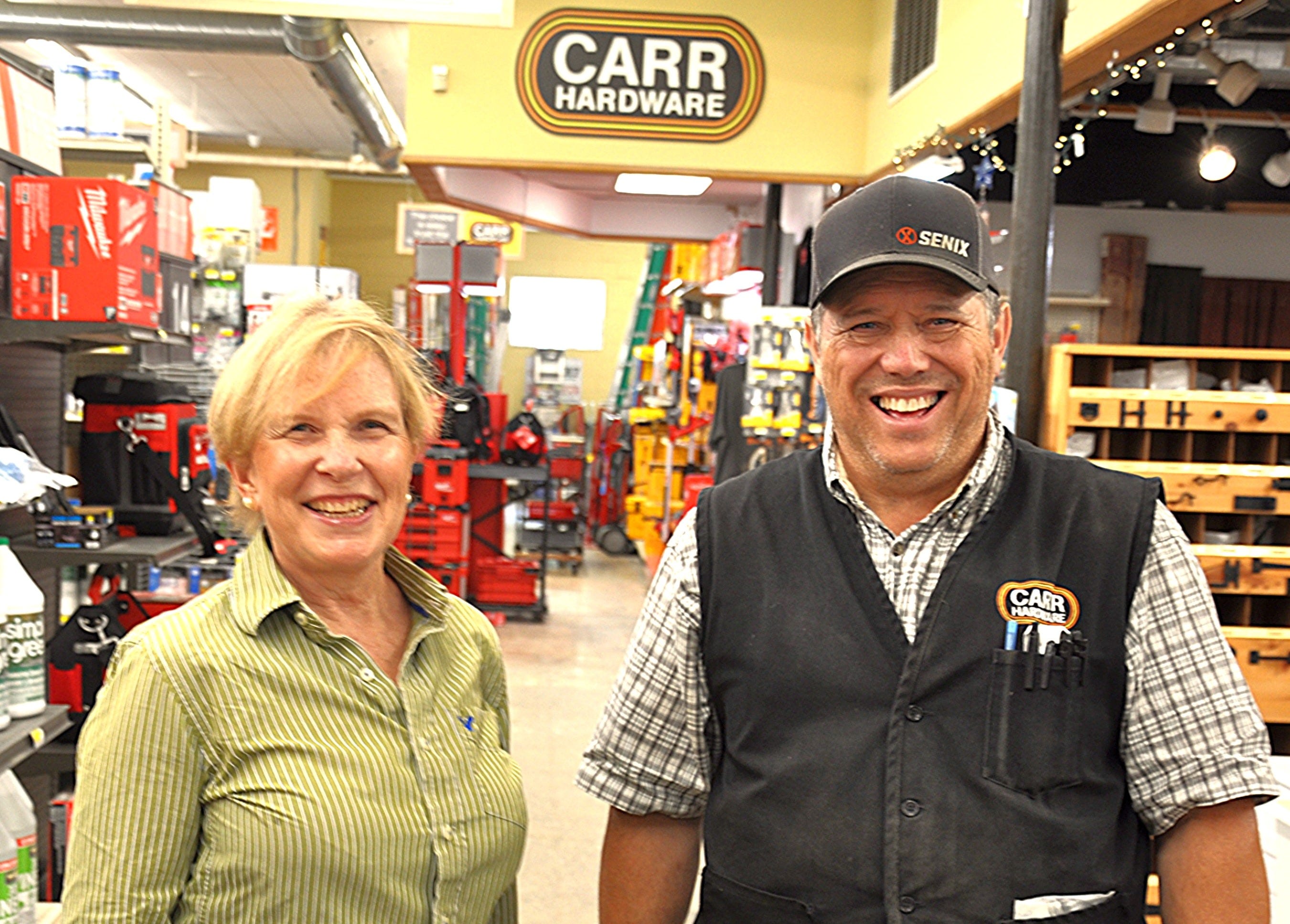
One of my French interlocutors wrote, in his book Nos Tiers-Lieux (Our Third Places), that Karen Christensen’s third place is the local hardware store. I used Google Translate, and oh did I laugh when I read that passage. No doubt about it: I have a soft spot for hardware stores. But Antoine based his account on one conversation we had by Zoom on an afternoon when I’d just returned from Carr Hardware. He took my enthusiasm for a good deal more than I intended. (I’ll include the text below.)
You’ll understand now why I was excited when Kathy Giuffre, the sociologist in Italy I interviewed last year on the podcast, emailed that she’d heard about a hardware store in Cabot, Vermont that has a bar in the back with live music. And it seems that Vermont is packed with hardware stores that are also social gathering spots. An article in the Wall Street Journal, of all places, did a rundown of several of these establishments: “Looking for a Good Time in Vermont? Try the Hardware Store” [gift link].
I then found that the New York Times Book Review feature that so boosted Ray Oldenburg’s The Great Good Place in December 1989 mentioned hardware stores:
As a boy growing up in Henderson, Minn., Ray Oldenburg, the author of “The Great Good Place,” traveled with his family on weekend shopping excursions to the nearest medium-sized town. His father would go to the hardware store, his mother to the dressmaker, and he would go to the five-and-dime. Later they would all meet in the local tavern, where other families also congregated.
That prominent review brought a flood of attention to the book and to the notion of a “third place.” It was the reviewer, Roberta Gratz, who all these years later exclaimed, “You’re not going to change it, are you? I loved that book!” She helped me see that I needed to write a sequel rather than try to revise Ray, and as a result his original is still available and our coauthored book will be its 21st-century companion.
Her review is thoughtful and worth reading today (available here). She quoted from the book, for example:
The official edicts and policies of despots are not the only means of shutting down the casual meetings of friends and neighbors essential to the democratic process. In the United States, we unwittingly accomplish the same end through the combination of mass construction technologies, zoning ordinances, and unimaginative planning. If developers intentionally built communities without local gathering places and good sidewalks leading to them from every home, and did so far the purpose of inhibiting the political processes of the society, we would call it treason. Is the result any less negative without the intent?
Carr Hardware
Here’s the delightful, though not accurate, passage in Nos Tiers-Lieux by Antoine Burret, translated by me with a good deal of help from Google:
I mentioned this anecdote to Karen Christensen, an American colleague who told me how lucky I was to be able to daily go on foot to drink coffee with friends in a bistro. We were in video conference and she was in her family home in a small town in the far west of Massachusetts, which serves as a second home for New Yorkers and Bostonians. She spoke with a lot of enthusiasm for sociability in cafes and with admiration of this culture European; I then asked her what her third place was. My question surprised her at first, and her face closed. She was silent for a few moments then admitted to me that she didn’t have one. . . . . She said would like to do like Ray Oldenburg and open a small bar for neighbors in her barn. The place would be perfect - it’s an old shed where the carriages were sheltered and which has kept its traditional architecture. But the legislation is rigid, there is zoning law and she would have to get a license to sell drinks. Oldenburg had certainly found a way to bring his bar under the radar of the law. She was thinking as she spoke and she came back to her first reaction. All things considered, she does have a third place. This may sound weird, but it’s a hardware store. Her house is old and she takes pleasure in maintaining it. For many years, a few days a week, she goes to the same store to buy her tools and her material. There she finds shop staff and other regular customers. They discuss their respective projects and give each other advice in the middle of the shelves or in front of the counter. They ended up knowing each other well to the point that she often goes there just to stroll, chat, and come out empty-handed.
From Nos tiers-lieux - Défendre les lieux de sociabilité du quotidien (Our third places - in defense of everyday social spaces), published in France in print only.
A conversation with Antoine Burret

Antoine and I started talking last summer while he was in final months of work on Nos Tiers-Lieux (Our Third Places), the first book on the subject to be written and published in France. Here we pick…
It’s true that I go to Carr Hardware fairly often—I can walk there in five minutes—and Ed is the staffer I turn to most often for advice. But I don’t hang out there and, regrettably, it is not a third place. I wonder if I could get them to put in a bar?
Harry’s Hardware
My favorite passage from the WSJ article mentioned above is about Harry’s, the Cabot, VT hardware store and bar:
At the next table over, two flannel-clad men bent over a game of double solitaire, like a scene from an old copy of the Saturday Evening Post. Tourists, it turned out. Tom Becker, 79, of Salisbury, Md., had spent much of the past year at his vacation home in nearby Lake Elmore, Vt.
“You can come down here in a snowstorm and play cards,” said Becker admiringly. His friend, Andy Char, 73, was in town from Forest Hills, N.Y. Char said he liked the egg rolls at Harry’s—even better than ones he’s found in Queens. But he was feeling the nostalgic vibes, too. “All it needs is a potbelly stove,” he said. “It’s the best of America.”
Why are storekeepers combining functions in a single location? This is how third places have existed throughout the world—patrons occupy a few chairs, an odd corner, a table in the back. The owners of Harry’s explain that the hardware store couldn’t really make it on its own, but when you add a bar and live music, there are different streams of income—different times and days, and different customers. Small towns and villages often lack a spot for informal socializing, and community-minded entrepreneurs are looking for ways to step in.
This documentary about Harry’s Hardware is about the store itself and also about the community’s response to the extreme flooding Vermont experienced in 2023.

Do you have a place like this where you live? Is there an opening for some enterprising person to create a hybrid business that will provide more opportunity for friends, neighbors, and strangers to meet and talk? Myself, I’m planning to head up to Harry’s one of these days.